Carbon Spring Steel Grades (XC65 to XC100 / EN 10270)
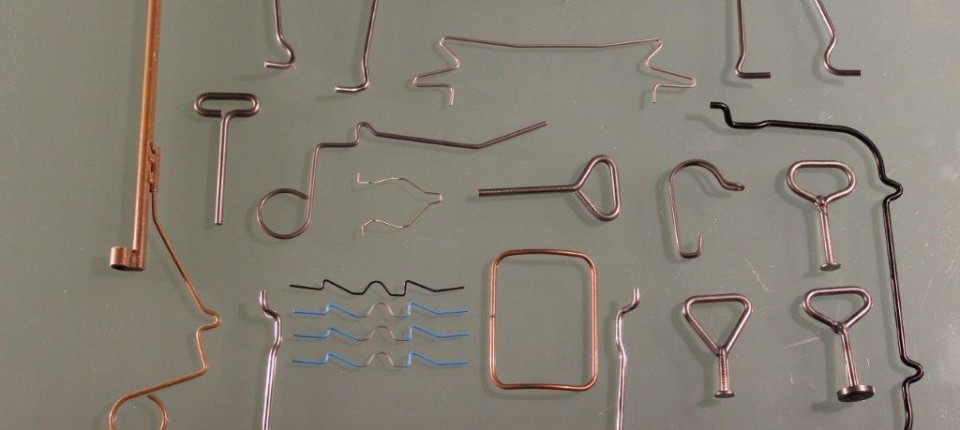
Select your hardened or annealed spring steel grades and leverage Filame's expertise for high-volume manufacturing of technical springs, clips, and formed parts on automatic presses and Bihler machines.
Spring steels are hard steels. Their hardness depends on their carbon content (above 0.45%) and on the fact that they have undergone a heat treatment process called quenching (or hardening). It is the hardness that gives the spring effect, i.e., the capacity for the material to return to its original state after the exercise of a force.
Quenching consists of heating a material to a so-called phase change temperature and then cooling this entire mass at a speed sufficient to trap the chemical elements that may have diffused into the crystalline solid at high temperature. The chemical elements becoming trapped contribute to the increase of certain mechanical characteristics of the quenched part. The hardening of steel (excluding special alloys) is generally carried out between 800° and 950°. To avoid an embrittlement effect of the material after quenching, a tempering is often carried out at a minimum of 200°.
Many variables influence the quality and mechanical properties of hardened steel:
- The quenching temperature
- The quenching time
- The cooling speed
- The chemical composition of the steel (such as carbon content and the content of other elements)
- Types of quenching: Air quenching (which causes scale/calamine), in a quenching liquid, or in a vacuum oven.
The main grades of hardened steel are XC65, XC75, XC80, XC90, and XC100. They are distinguished by their hardness. The most standard is XC75, i.e., a steel with a carbon content of 0.75%.
Hardness Conversion Table
| Tensile Strength RM (Mpa) | Hardness HV | Hardness HRB | Tensile Strength RM (Mpa) | Hardness HV | Hardness HR 30N | Hardness HR 45N | Hardness HRC |
|---|---|---|---|---|---|---|---|
| 330 | 100 | 55 | 1020 | 320 | 54 | 34 | 32.2 |
| 390 | 115 | 64.6 | 1090 | 340 | 55 | 37 | 34.4 |
| 440 | 130 | 71 | 1120 | 350 | 56 | 38 | 35.5 |
| 510 | 155 | 80.5 | 1160 | 360 | 57 | 39 | 36.6 |
| 580 | 180 | 87.3 | 1220 | 380 | 58 | 42 | 38.8 |
| 630 | 195 | 91.7 | 1290 | 400 | 60 | 44 | 40.8 |
| 690 | 215 | 94.6 | 1360 | 420 | 62 | 47 | 42.7 |
| 740 | 225 | 97 | 1430 | 440 | 64 | 49 | 44.5 |
| 810 | 245 | 100 | 1500 | 460 | 65 | 51 | 46.5 |
| 880 | 265 | 103 | 1570 | 480 | 66 | 53 | 48.0 |
| 960 | 300 | - | 1650 | 500 | 68 | 54 | 49.5 |
Hardness equivalence table given for information only
Design Your Spring
Use Filame’s interactive calculation tool to size and preview your spring. Compute rates, loads, Wahl stress corrections, and submit verified parameters for rapid quoting.
Production capacities
Discover Filame's production capabilities in Carbon Spring Steel Grades (XC65 to XC100 / EN 10270):