

Filame Enhances Galvanic Corrosion Resource with Interactive Risk Calculator & 26-Metal Matrix
Filame introduces an interactive galvanic corrosion risk calculator and 26-metal compatibility matrix (ASTM G82) to prevent bimetallic degradation.
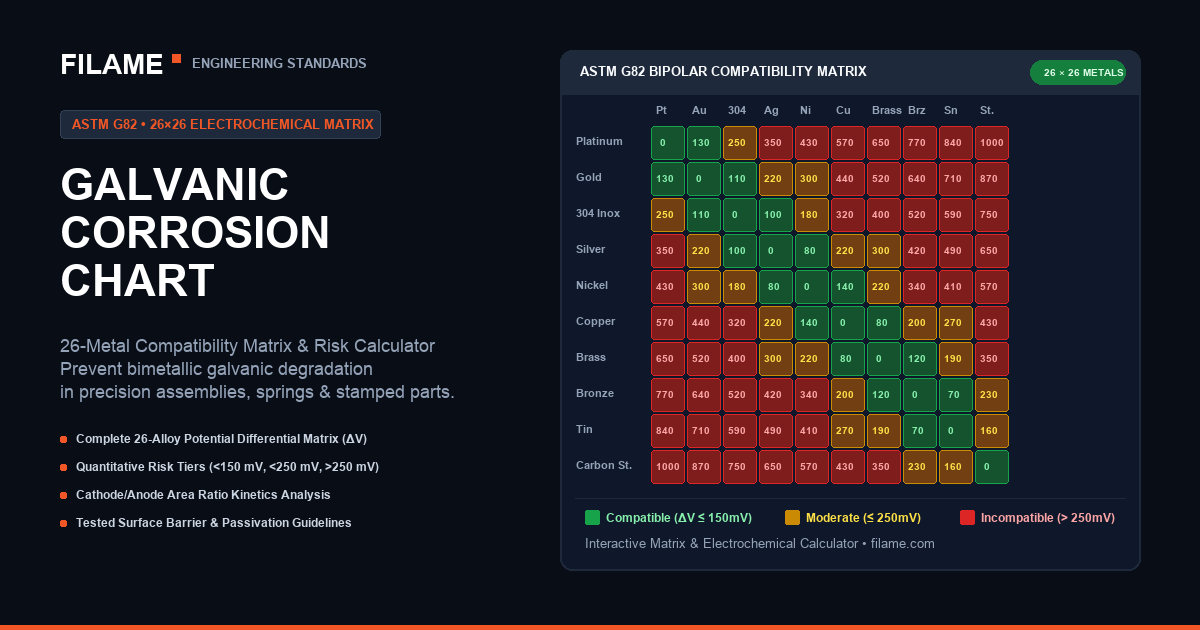
The Filame Group is pleased to announce a major functional update to its technical resource: Galvanic Couples & Metal Corrosion Chart.
In modern industrial equipment—spanning automotive chassis, aerospace assemblies, rail transport, and renewable energy installations—engineers frequently assemble multi-metal configurations. Fastening a stainless steel clip onto an aluminum housing or mating copper electrical terminals to structural steel brackets creates an electrochemical couple. In the presence of moisture or salt fog, this coupling can trigger severe galvanic corrosion, leading to premature mechanical failure.
To help designers prevent these risks early in the development process, Filame has integrated two powerful engineering tools directly into the page.
1. Interactive Galvanic Risk Calculator
The newly deployed Galvanic Risk Calculator enables mechanical and metallurgical engineers to simulate real-world galvanic interactions with precision:
- Select Any Metal Pair: Choose from 26 common industrial alloys and surface coatings for both Component A and Component B.
- Environmental Severity Mapping: Select your operational environment—from controlled indoor atmospheres (ΔV ≤ 250 mV) to harsh marine and de-icing salt-spray environments (ΔV ≤ 150 mV).
- Surface Area Ratio Factor: Account for the crucial geometric area effect (small anode vs. large cathode or vice versa).
- Instant Diagnostic & Recommendations: Receive instantaneous electrochemical potential deltas (|ΔV|), safety classification (Safe, Moderate Risk, Severe Risk), and tailored mitigation advice (alloy substitution, plating, or dielectric isolation).
2. Comprehensive 26-Metal Compatibility Matrix (ASTM G82)
Alongside the calculator, the page features an expanded, color-coded Compatibility Matrix based on the ASTM G82 galvanic series in marine and industrial electrolytes. This table allows engineers to cross-reference potential differences at a glance across noble superalloys (Inconel, Titanium, Platinum), austenitic and martensitic stainless steels, copper alloys, structural steels, aluminum alloys, and sacrificial zinc platings.
Filame’s Manufacturing & Co-Engineering Solutions
Preventing galvanic degradation is a foundational aspect of Filame’s co-engineering approach for serial production:
- Compatible Fasteners & Spring Clips: Precision stamping and forming of spring clips and fasteners engineered from electrochemically compatible alloys.
- High-Performance Surface Platings: Certified application of Zinc-Nickel coatings, zinc flake systems (Geomet/Dacromet), and chemical passivation per our surface treatments portfolio.
- Volume Stamping & Pressing: High-speed press runs up to 320 tonnes with integrated optical metrology in our stamping division.
Explore the interactive tools today:
- Test your material combinations on the updated Galvanic Corrosion Guide & Risk Calculator.
- Sizing precision springs? Validate your dimensions with our Online Spring Calculator.
- Request an engineering consultation or production quote via our Contact & RFQ Desk.