

Filame Publishes Technical Guide on Non-Magnetic Springs and Low-Permeability Alloys
Discover Filame's technical guide on non-magnetic springs, relative permeability (μr), and alloy selection for medical, aerospace, and precision systems.
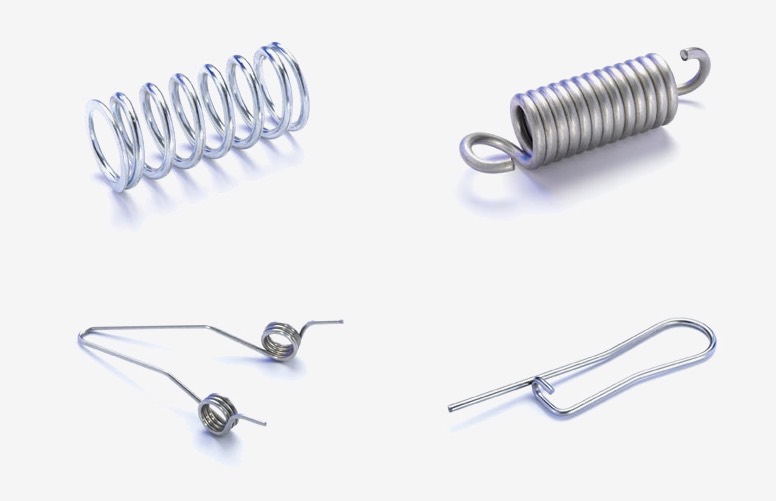
Following an increasing volume of client inquiries from engineering teams in medical instrumentation, aerospace avionics, and high-precision electronics, the Filame Group has published an in-depth engineering resource: Non-Magnetic Springs: Which Alloys Should You Choose?.
In high-sensitivity environments—such as Magnetic Resonance Imaging (MRI) apparatus, particle detectors, satellite navigation units, and precision electromechanical relays—mechanical springs must deliver exceptional elastic endurance without perturbing external magnetic fields.
The Hidden Trap: Cold Work Martensite in Austenitic Stainless Steels
Designers frequently assume that standard stainless steels like AISI 301 or 302 will guarantee magnetic neutrality. However, manufacturing high-tensile spring wire requires heavy cold drawing. This plastic deformation triggers a partial phase transformation from meta-stable austenite into ferromagnetic deformation martensite.
As a consequence, springs produced from cold-worked standard stainless steel exhibit noticeable magnetic attraction, with relative magnetic permeability ($\mu_r$) frequently climbing above 1.1 to 2.0. In medical and aerospace sensors, this unexpected residual magnetism can distort measurement signals or compromise calibration.
Comprehensive Alloy Selection & Interactive Filtering
Our new technical guide breaks down the physical properties, temperature windows, and magnetic permeability ratings of the premier amagnetic spring alloys:
- Cobalt-Chromium-Nickel Superalloys (Phynox / Elgiloy): Exceptional mechanical resistance, biocompatibility, and virtually perfect magnetic transparency ($\mu_r \approx 1.0004$) across a wide temperature spectrum (-196°C to +450°C).
- Beryllium Copper (CuBe2 / C17200): Superior electrical and thermal conductivity combined with absolute magnetic neutrality ($\mu_r \approx 1.0000$), making it the benchmark for electrical contacts and measuring probes.
- Nickel-Chromium Superalloys (Inconel 625 & 718): Extreme corrosion resistance and low permeability ($\mu_r \approx 1.0006$) for marine subsea transducers and high-temperature aerospace valves.
- Special Austenitic Stainless Steels (AISI 316L / 1.4404): Significantly reduced magnetic susceptibility compared to 301/302, suitable for moderate industrial non-magnetic applications.
The guide also features an interactive alloy selector and a side-by-side metallurgical comparison matrix, allowing engineers to filter materials by permeability threshold, operating temperature, and tensile strength.
Co-Engineering Support for Your Critical Spring Assemblies
Whether you require micro-springs for medical implants or robust suspension components for aerospace systems, Filame’s engineering office assists you from initial CAD sizing to serial manufacturing:
- Explore the complete technical guide: Non-Magnetic Springs Selection Guide.
- Verify dimensional loads and stress parameters with our Online Spring Calculator.
- Consult our Springs & Wire Forms Catalog to review our coiling, grinding, and wire-forming capabilities.
- Submit your 2D drawings or 3D STEP files directly through our Contact & RFQ Desk for technical feasibility review and rapid quotation.